
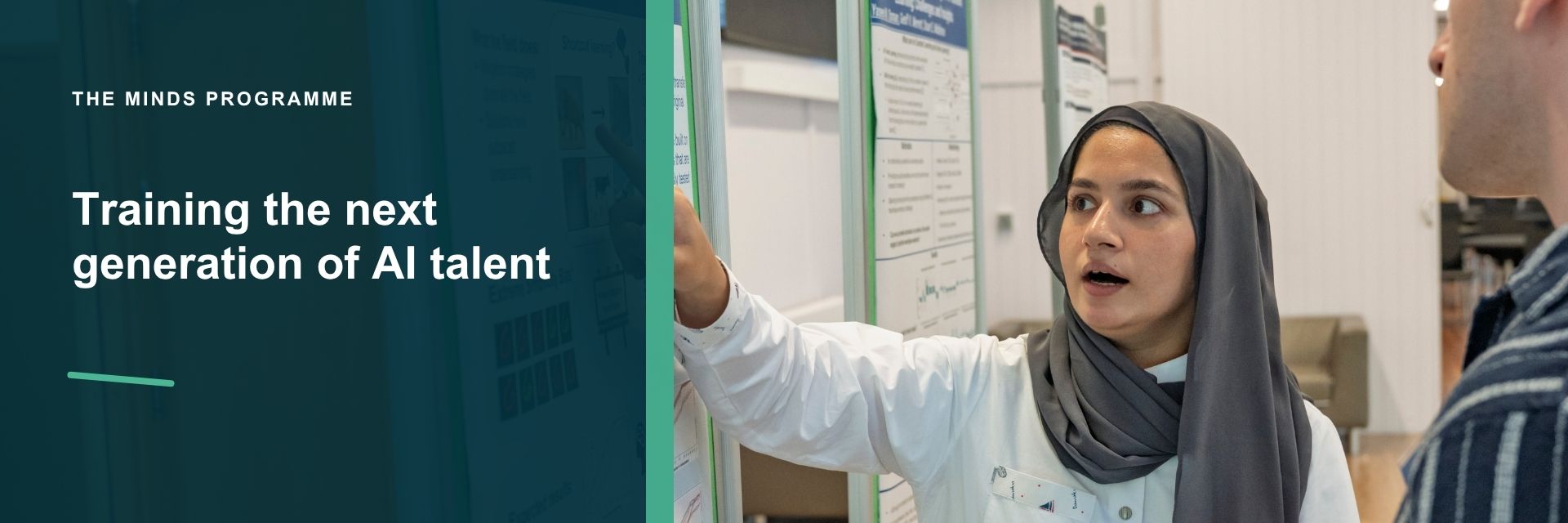
The MINDS iPhD is a four-year integrated doctoral programme combining a structured first year of taught training with three years of supervised research.
It was designed around a specific insight: that the most important problems at the intersection of machine intelligence and nanoelectronics require researchers who are genuinely fluent in both fields; not specialists who have crossed briefly into adjacent territory.
The first year builds that fluency deliberately, through a combination of core MINDS modules and a tailored selection of advanced courses drawn from computer science and electronics. The second to fourth years are the research itself: individual doctoral projects, each associated with one or more of the CDT’s four research themes, each supervised by an interdisciplinary team that typically includes an industry advisor.
Intake was approximately 12 researchers per cohort, across five cohorts from 2019.
Year 1: Training and foundations
The first year of the MINDS programme was structured to give every researcher a common grounding across machine intelligence and nanoelectronics; regardless of whether their undergraduate background was primarily in computer science, electronics or engineering. Two core MINDS modules ran across the year, with a tailored selection of advanced modules chosen in discussion with supervisors to match each researcher’s background and research direction.
Semester 1
Two core MINDS modules formed the spine of the first semester, with one ELEC (electronics) and one COMP (computer science) optional module selected to match each researcher’s prior knowledge and intended research direction.
- MIND6001 Impact and Communication Strategies
- MIND6002 Technologies, Modules and Algorithms
- COMP6203 Intelligent Agents
- COMP6246 Machine Learning Technologies
- COMP6245 Foundations of Machine Learning
- ELEC6254 Foundations of Embedded IoT Systems
- ELEC6237 Secure Hardware and Embedded Devices
- ELEC3207 Nanoelectronic Devices
Semester 2
The Interdisciplinary Team Project (MIND6003) was the centrepiece of Semester 2 a collaborative module that brought researchers from across the cohort together to tackle a shared challenge. Two additional COMP or ELEC modules were selected to deepen knowledge in the areas most relevant to each researcher’s emerging project.
- MIND6003 Interdisciplinary Team Project
- COMP6207 Algorithmic Game Theory
- COMP6208 Advanced Machine Learning
- COMP6257 Bayesian, Active & Reinforcement Learning
- COMP6258 Differentiable Programming and Deep Learning
- ELEC6207 Quantum Devices and Technology
- ELEC6214 Advanced Wireless Communications Networks and Systems
- ELEC6232 Analogue and Mixed Signal CMOS Design
- ELEC6234 Embedded Processors
Summer
The summer of Year 1 marked the transition from taught training to doctoral research. Researchers began working directly with their supervisory team on MIND6004, the Feasibility Study, which scoped the individual research project that would carry through Years 2 to 4.
Years 2-4: Doctoral Research
Years 2 to 4 of the MINDS programme were the core research phase. Building on the feasibility study completed at the end of Year 1, each researcher worked with a dedicated supervisory team typically including academics from across disciplines and an industry advisor to develop and complete an original doctoral project.
All MINDS projects were associated with one or more of the CDT’s four research themes and took a cross-disciplinary approach as a matter of programme design, not just aspiration. Industry and government partners had active input into project supervision, and researchers had access to the full range of MINDS facilities and networks throughout.
The emphasis throughout was on research that was genuinely disruptive; work that crossed disciplinary boundaries while remaining aware of its potential implications for society, security and safety.
Research Themes
MINDS research is organised around four themes, each addressing a different aspect of the same underlying challenge: how to make AI work intelligently, efficiently and reliably in physical devices and distributed systems. Most projects drew on more than one theme, reflecting the CDT’s emphasis on cross-disciplinary approaches.
Training and Support
Research at the interface between AI and electronics requires thinking differently about the interdependencies between the two disciplines their underpinning mathematics, statistics, algorithmic techniques and device physics. The MINDS CDT was structured to build that breadth deliberately, drawing on expertise across both fields.

Cross-Disciplinary Expertise
MINDS researchers gained broad awareness across AI and electronics through a combination of core and tailored modules, selected to match each researcher’s academic background and research direction. All researchers followed a combination of computer science and electronics modules covering areas including deep learning, online and reinforcement learning, intelligent agents, nanoelectronic devices, embedded processors, and analogue and mixed signal systems design. This cross-disciplinary foundation was put into practice through a team project addressing a challenge set by one of the CDT’s industry or government partners, with outcomes demonstrated at the annual showcase.
Innovation Camp
Each year, MINDS researchers attended a week-long, student-led innovation camp. Activities ranged from enhanced technical training and research commercialisation workshops run with SetSquared, to the development of outreach activities and, inevitably, social ones.
STARs Programme
The STARs programme gave MINDS researchers a structured framework for short-term, focused collaborative research with peers across the CDT. Researchers could connect with others working in related areas to explore new ideas, exchange best practice, learn new techniques and tools, or gain perspective across disciplines. Industry partners were included in the network.
Outreach & Public Engagement
All MINDS researchers took part in outreach and public engagement activity, communicating the societal value of AI and electronics research and inspiring others toward the field. Through the CDT’s Ambassadors’ Programme, several researchers received enhanced training in outreach leadership.