
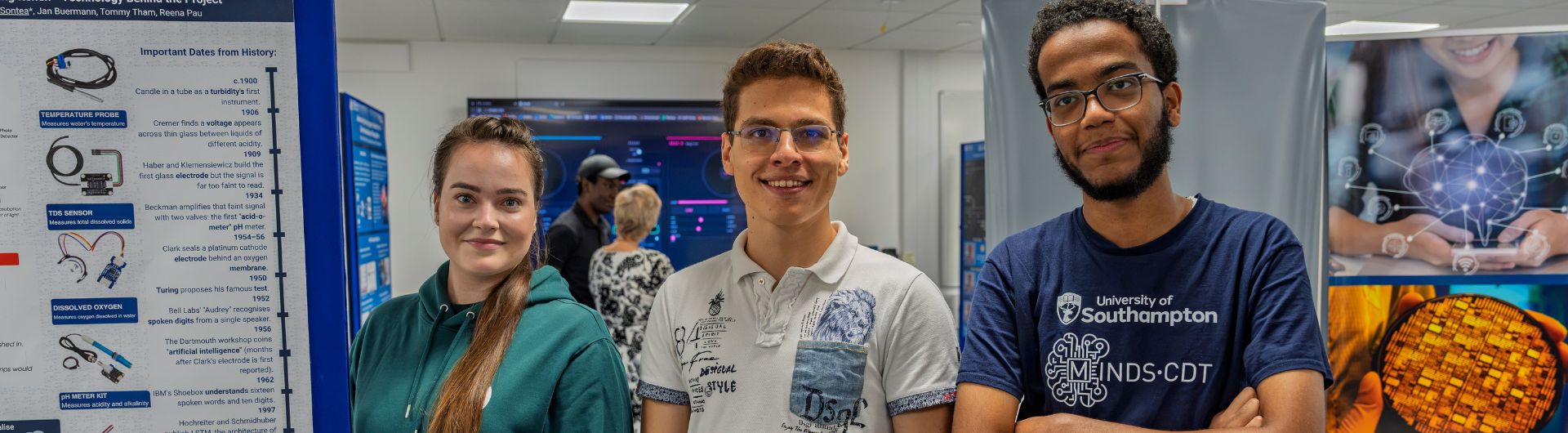
Several of the children who joined the Talking Itchen sessions earlier this year arrived sure that AI was harmful. By the final sessions, some had changed their minds. A few said their takeaway was that AI isn’t bad in itself and can be used for good.
MINDS postgraduate researcher Yaseen Osman taught the AI part of those sessions. His PhD looks at running large language models efficiently on personal devices. With Talking Itchen, he took the same technology somewhere less expected: a river.
Giving the River Itchen a voice
Talking Itchen connects water-quality readings, including dissolved oxygen, pH, turbidity, temperature and total dissolved solids, to an AI model. The model explains what the readings mean for the health of the River Itchen, a chalk stream and a birthplace of Atlantic salmon. Yaseen works on the language model behind the river’s answers, with SustAI postgraduate researchers Angelina Spilnyk and Andrei Șontea.
The project began as Talking Plant, the runner-up idea at the hackathon during the 2025 MINDS and SustAI Innovation Camp. The team then turned it towards a local river, supported by MINDS CDT Enterprise Fellows Jan Buermann and Tommy Tham.
For Yaseen, the point was to show AI in an unexpected role, using it to “bring character to a river to raise awareness in a unique way.”
From one dimension to thousands
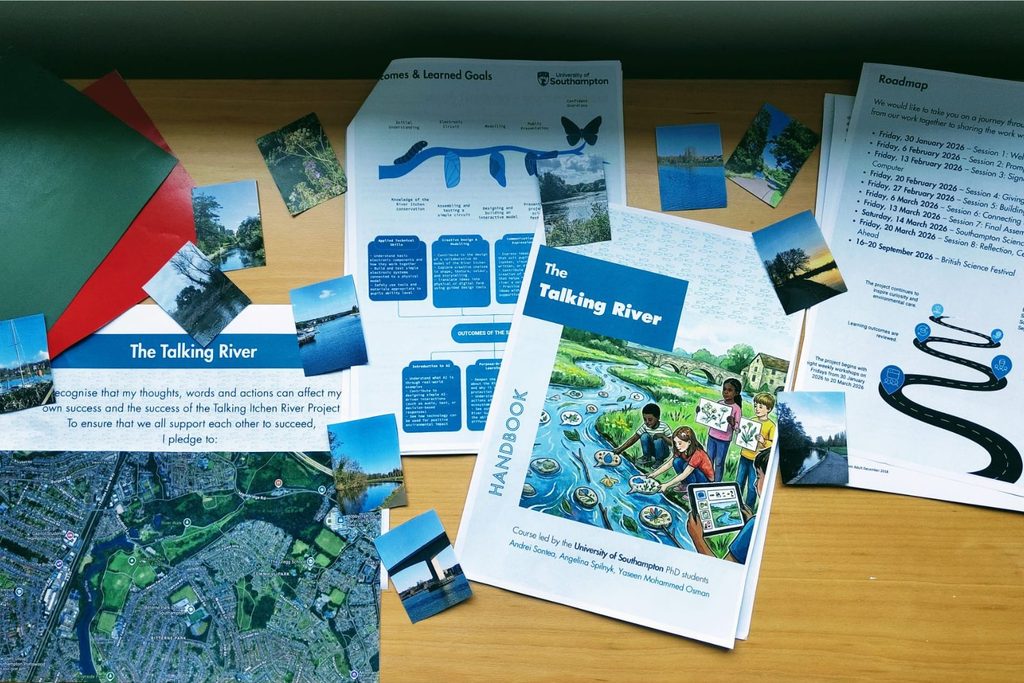
Over the winter, ending in March, the team ran eight weekly sessions with 19 children from the Young Guardians of the River Itchen. Andrei led electronics and sensors, Angelina led behavioural design and river law, and Yaseen led AI and large language models.
His sessions started with a simple, imaginary language model with a single dimension, then built up to the thousands of dimensions that real models use. In March, seven of the Young Guardians joined the team at the Southampton Science and Engineering Festival and explained their own work to visitors.
A river that gets asked about everything
At the British Science Festival on Saturday 19 September 2026, Talking Itchen met its biggest audience yet. Visitors engaged well, Yaseen says, and some began asking the river questions that had nothing to do with rivers, just to see how it would answer.
Others wanted to know where the model ran: in the cloud, or on the University’s own servers. That question sits close to Yaseen’s research, which looks at keeping AI models on local hardware so data stays private.
For Yaseen, public engagement is a test of the work itself. It shows researchers whether what they build in the lab is a useful solution for the people it is meant to serve.
Read Angelina Spilnyk’s and Andrei Șontea’s stories on the SustAI website, or read about all four demonstrations in our British Science Festival round-up.