
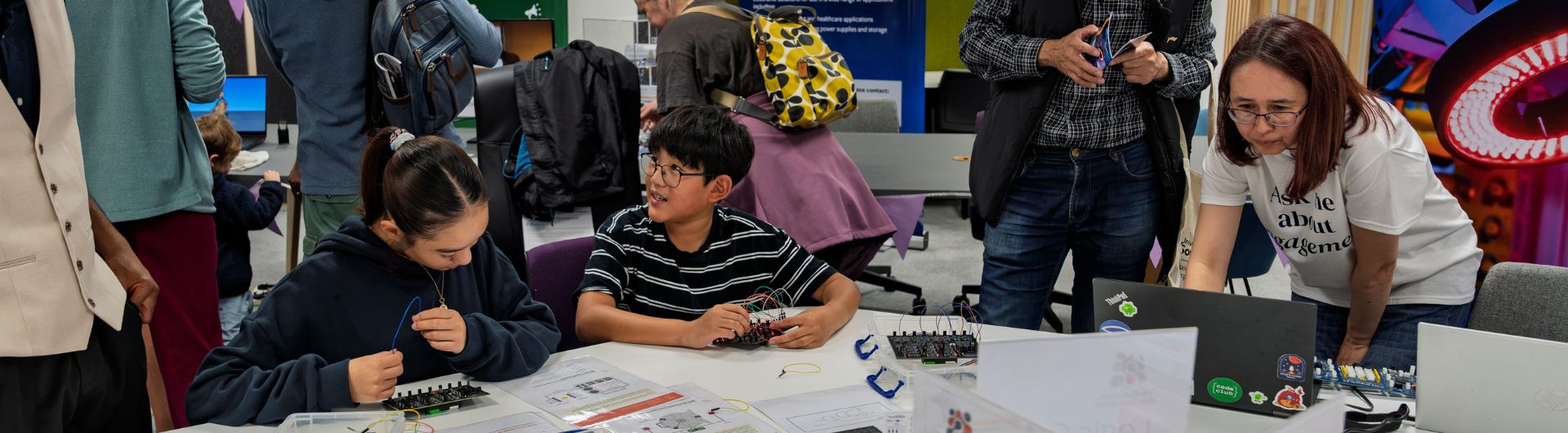
A visitor at the British Science Festival asked one of our robots to tell them the time. It got the answer wrong. For MINDS postgraduate researcher Yaseen Osman, the question mattered more than the mistake. It pointed to a practical accessibility use for the robots that hadn’t been the project’s focus until someone in front of him needed it.
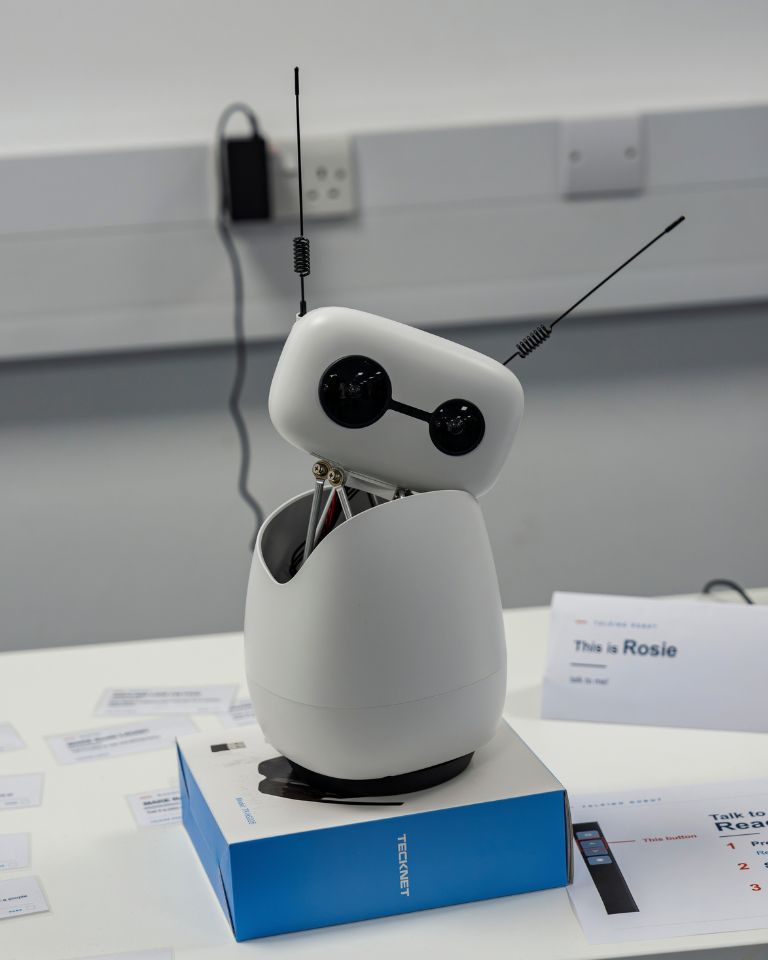
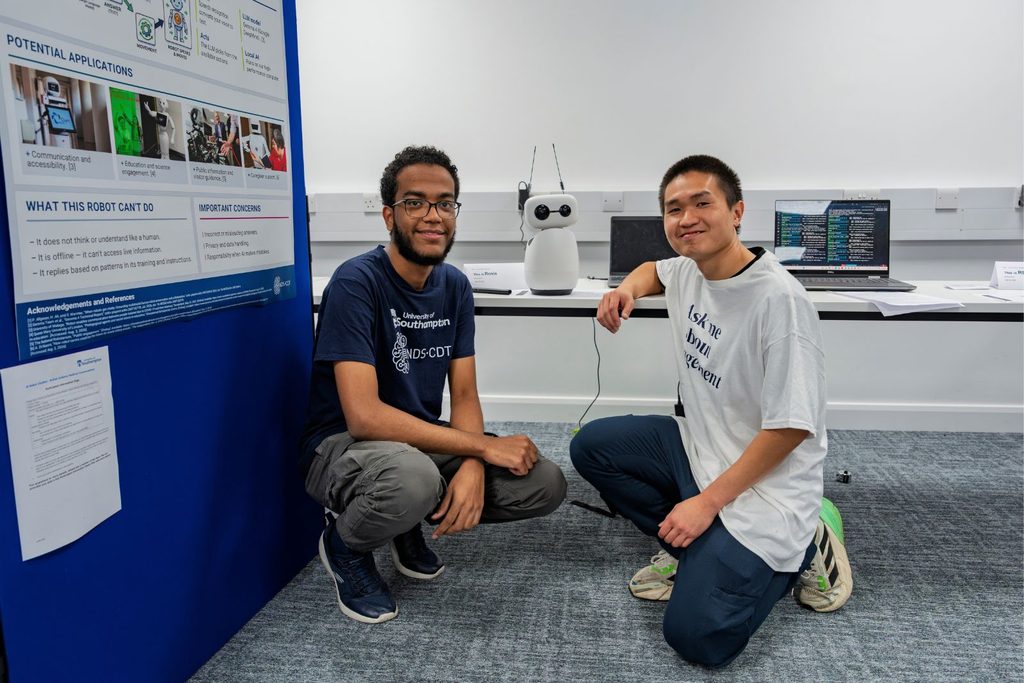
Exchanges like that were the point of the stand. On Saturday 19 September 2026, MINDS CDT Enterprise Fellow Tommy Tham and Yaseen ran a demonstration in the Sir James Matthews Building with two conversational robots, Rosie and Reachy. Both hold spoken conversations on almost any subject a visitor raises.
Robots that run on our own servers
The conversational AI behind Rosie and Reachy runs on servers hosted at the University of Southampton, with no cloud service involved. Tommy chose that set-up with security and sustainability in mind. Earlier this year, the project placed third out of 24 entries in the Best Artifact category at the ECS Student Showcase.
Where the model runs came up at the Festival too. Visitors asked Yaseen whether the AI ran in the cloud or locally. That led to a conversation about why a hospital might keep a model on its own servers for privacy. The question sits close to Yaseen’s PhD, which looks at running large language models efficiently on personal devices, so data can stay with the person using them.
Showing the limits as well as the tricks
Tommy wanted visitors to see the robots’ weaknesses as clearly as their strengths. “Technologies such as conversational AI can appear very capable when people first interact with them,” he says. As a researcher, he sees helping people recognise that as just as important.
The busy hall put that to the test. Visitors were impressed by some of what the robots could do. They also watched them struggle with response speed and with filtering out background noise.
Many people used the robots as a teaching aid. One visitor asked for an explanation of quantum entanglement. Another asked Rosie what she made of Reachy. When a visitor at the neighbouring Talking Itchen stand asked how attention mechanisms work in large language models, Yaseen explained, then put the same question to one of the robots. It gave a clear answer of its own, in front of the visitor.
A conversation that runs both ways
“It helps to show how research can translate into something meaningful and relevant to everyday life,” Tommy says. “It is also an opportunity to inspire people to become involved in science and research, while creating a two-way dialogue. Hearing people’s questions, concerns and expectations can help researchers better understand public needs and inform the direction and impact of future research.”
For Yaseen, public engagement shows whether work in the lab is useful to the people it’s meant for. Seeing visitors enjoy a demonstration is also, in his words, “a nice change”, and it keeps him motivated.
One of the most memorable reactions came from a young visitor who had been considering a non-STEM degree. They told Tommy the demonstration had made them reconsider studying a STEM subject at university.
Read about all four demonstrations in our British Science Festival round-up.