
MINDS CDT doctoral researcher | University of Southampton
Helping AI models look beyond the easiest clue in their data
Formal project title: Improving Robustness of Lightweight Models through Decision Compositionality
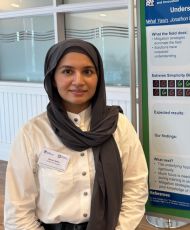
Nehal Yasin is a doctoral researcher working on robust generalisation in machine learning, with a focus on shortcut learning, also known as simplicity bias. Her research explores how models could be helped to learn a wider range of patterns from their training data, so that they perform as well in the real world as they do in the lab.
Research at a glance
| Research focus | Shortcut learning and robust generalisation in machine learning |
| MINDS theme | Embedded Artificial Intelligence |
| Methods and technologies | Deep learning, representation learning, saliency maps, learning dynamics |
| Main field | Computer vision |
| Supervisors | Jonathon Hare and Antonia Marcu |
| Current status | Doctoral researcher |
| Expected completion | 2027 |
Why AI models take shortcuts
Machine learning models often perform well in controlled lab settings but struggle once they are deployed in the real world. There are many reasons for this. Nehal is particularly looking at one of them: shortcut learning.
Shortcut learning happens when a model relies on the simplest, easiest-to-learn patterns in its training data and ignores the other patterns available to it. For example, a model might identify an elephant by its grey texture, or a bird by a blue background, rather than by its shape. Learning a pattern that exists in the data is justifiable, Nehal explains, but ignoring all the other existing patterns is problematic.
Her research shows how strong that pull can be. In work presented at a NeurIPS 2024 workshop, Nehal added a single coloured pixel to each training image, with its colour giving away the correct answer. The models came to depend on that one pixel and ignored all other information. With the pixel present, they classified almost every test image correctly. Without it, accuracy fell to chance.
Her PhD explores how models can be encouraged to learn diversified patterns from their training data, so that their decisions do not rest on a single clue.
Why the research matters
AI that holds up outside the lab
Models that draw on a wider range of patterns could be more dependable when the conditions they meet in use differ from those in their training data.
A problem across AI
Shortcut learning affects language, audio and vision models alike, so a better understanding of it could be relevant well beyond any one application.
Understanding what models learn
Her work aims to contribute to AI that can explain what it has learned, which could help people judge when a model’s decisions can be trusted.
Research approach
Nehal looks inside models to understand what goes wrong. She studies their internal composition, learning dynamics, weight updates and gradients to find out why a model comes to rely on something irrelevant.
So far, this has included testing whether saliency maps, a widely used way of showing which parts of an image a model relied on, are reliable, and examining whether widely adopted hypotheses about shortcut learning hold true across different settings. Her work draws on deep learning and representation learning.
Research and outputs
Is Saliency Really Captured By Gradient?
Presented as a poster at the NeurIPS 2024 Workshop on Scientific Methods for Understanding Deep Learning, with Jonathon Hare and Antonia Marcu. Many explainability tools use gradients to highlight the parts of an image a model relied on. The paper explores how these saliency maps are not reliable enough to show which areas a model relies on when making predictions.
Read ‘Is Saliency Really Captured By Gradient?’ on OpenReview | View the paper in the University of Southampton repository
Hypotheses about shortcut learning don’t generalise: rethinking approaches to systematic evaluation
A poster paper at the NeurIPS 2026 Workshop on Self-Evolving Diversity-Driven Search for Robust AI Systems, with Antonia Marcu and Jonathon Hare. It argues that widely adopted hypotheses about shortcut learning are not universal, and should be examined before they form the basis of strategies to reduce it.
View the paper’s listing on the NeurIPS 2026 website
Awards
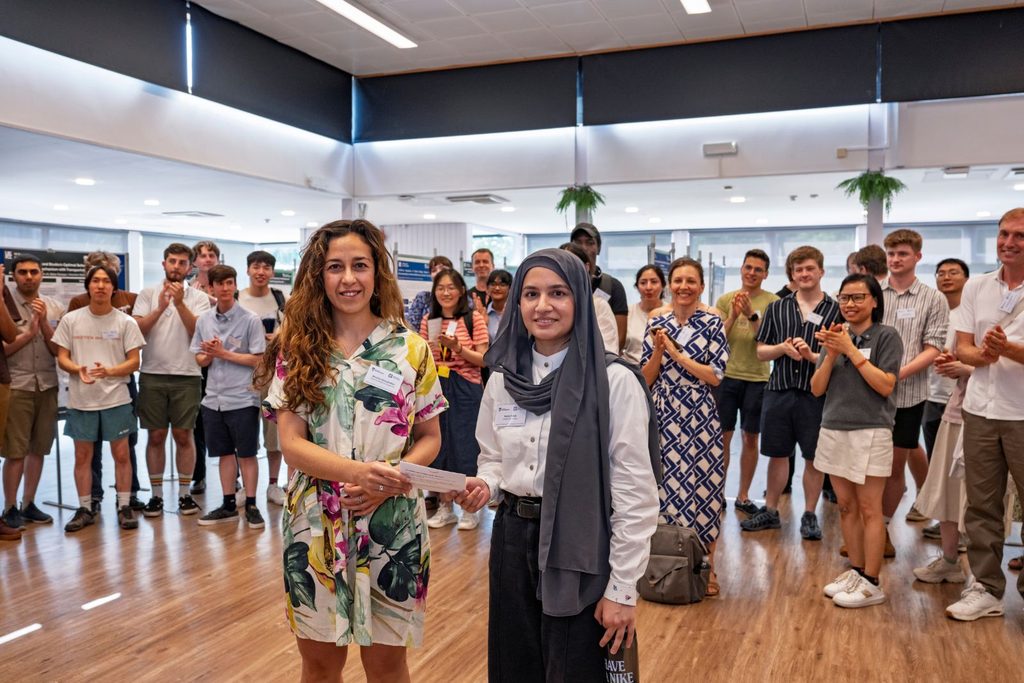
- Best poster, MINDS poster competition, 2026 MINDS and SustAI Showcase, for the poster ‘Understanding Shortcut Learning’
- Best poster, MINDS poster competition, 2025 MINDS and SustAI Showcase
Looking ahead
After her PhD, Nehal hopes to continue working in research, in industry or academia, alongside people working in representation learning. Computer vision is her main field, and she is open to working with other modalities.
Related stories
Get in touch about Nehal’s research
Interested in robust machine learning, shortcut learning or representation learning? Contact the MINDS team about research, collaboration or recruitment enquiries, and we can connect you with Nehal.