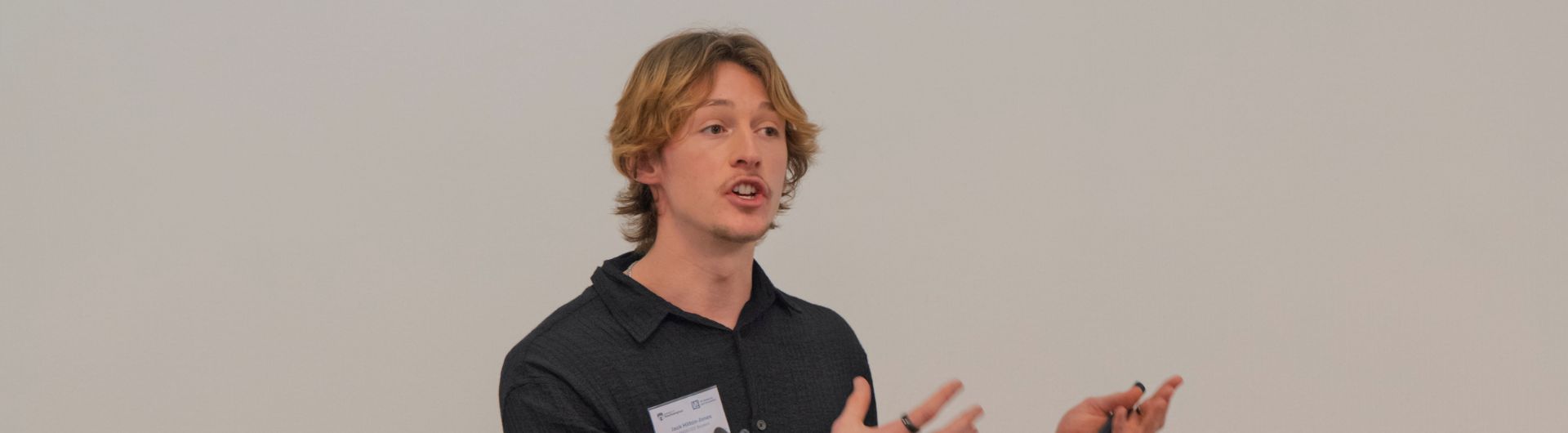
Jack Hilton-Jones is developing robots that could one day travel through a patient’s blood vessels on their own. At the 2026 MINDS and SustAI Showcase on 24 June, the MINDS postgraduate researcher presented that work to industry partners, policymakers and academics, in a talk titled “Autonomous Magnetic Continuum Robotics for Endovascular Interventions”.
Safer routes through the body
“I’m working on magnetic continuum robots to advance safety for healthcare in surgical robotics,” Jack says in the Showcase highlight film. His robots are flexible devices, steered through blood vessels by a magnetic field from an external robotic arm, without the mechanical pull-wires used to steer many devices.
One use is mechanical thrombectomy, the procedure used to remove a blood clot from the brain after a stroke. It is time-critical, needs highly trained specialists, and is not available in every hospital. A more autonomous and predictable robot could help make it safer, faster and easier to access.
Getting a robot to steer itself safely means knowing when it can rely on its own judgement. Jack analysed more than 1,600 controller events and used what he found to build a hierarchical controller that learns when to trust its predictions and when to pull back.
He came to the work from mathematics, and his research now brings together AI, control theory, robotics and healthcare. In the longer term, he sees robotics helping to deliver treatment in local centres, so patients can be treated sooner.
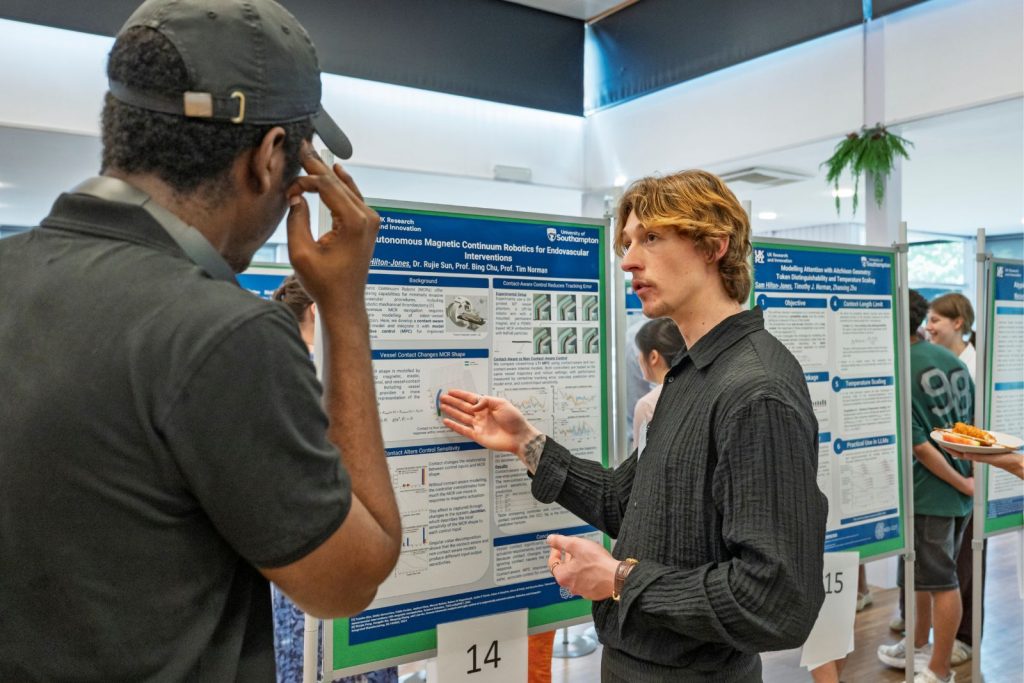
Learning from those a few steps ahead
For Jack, one of the most valuable parts of the day came from people who had already finished their PhDs. MINDS alumni, including Jack Dymond and Mark Towers, returned to talk about their careers since.
“I especially enjoyed the alumni speakers returning and sharing their journey after the PhD,” he says. “I thought their advice on the steps we can take to put ourselves in the best position during the PhD was invaluable.”
The Showcase was also a chance to build connections across both programmes. “The entire day allowed me to connect with fellow students and speakers, which is part of the experience of being part of a cohort and a CDT.”
What comes next
After his PhD, Jack hopes to work as a robotics engineer, with a particular interest in space robotics. He is due to graduate in 2027.