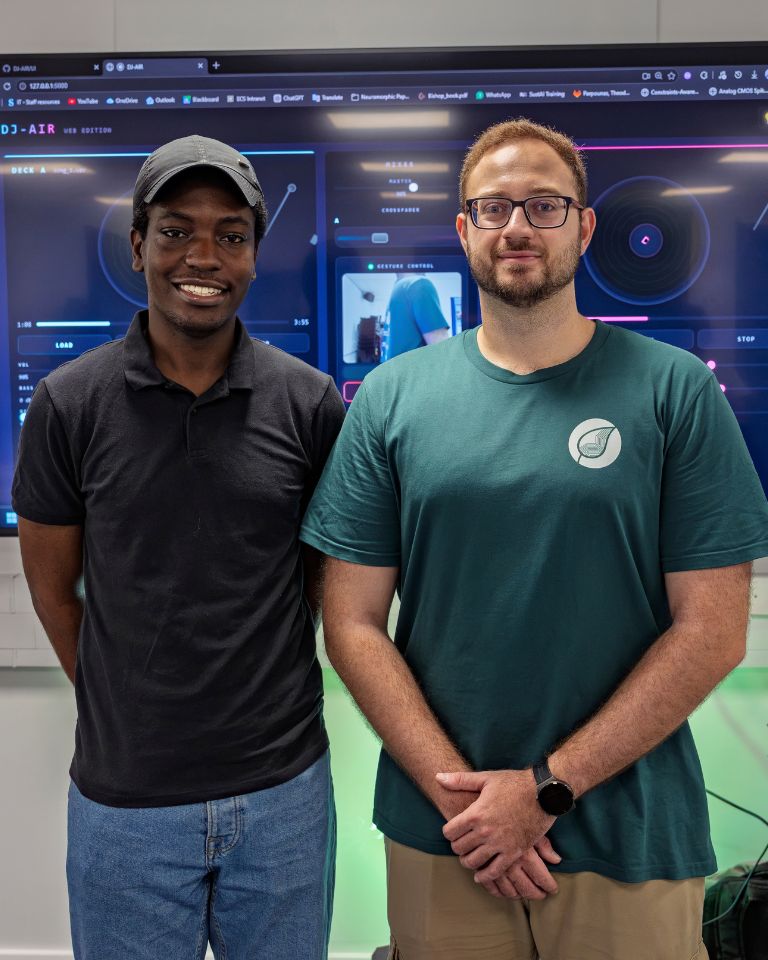
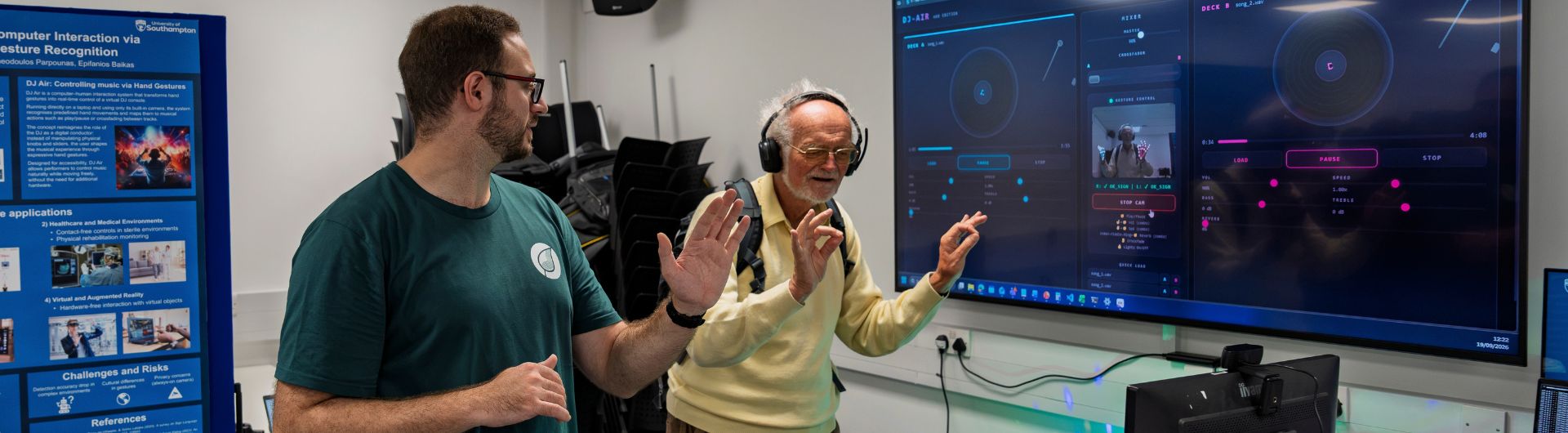
Most visitors to the DJ Air stand at the British Science Festival expected to find specialist kit. Many assumed it would need something like Microsoft’s Kinect, which combines colour and infrared cameras to read gestures. What they found was a laptop and its built-in camera.
According to SustAI postgraduate researcher Theo Parpounas, who ran the stand on Saturday 19 September 2026, visitors were “surprised by the simplicity of the equipment required to achieve this touchless control.”
DJ Air lets you mix tracks and control lighting with hand gestures alone. It was built by MINDS postgraduate researchers Keniel Peart, Rudra Mutalik and Epifanios Baikas, with Theo. Earlier this year it won Best Demonstration at the ECS Student Showcase.
From hackathon idea to award winner
DJ Air began as the winning idea at the hackathon during the 2025 MINDS and SustAI Innovation Camp. Rudra was on that original team and wrote much of the main software.
“The motivation was to demonstrate a novel, more accessible and more engaging method of interacting with a DJ deck,” he says. A professional DJ deck can cost hundreds or thousands of pounds. The team wanted something that needed nothing beyond a laptop.
They also designed it for performing. A DJ needs to watch the crowd, not a keyboard, and to move. Gesture control answered both. The team tried running the software on a small Raspberry Pi-style computer, but it couldn’t keep up in real time, and a laptop is easier for anyone to get hold of.
Seeing depth in a flat image
The hardest part was recognising the gestures themselves. The software could track a user’s hand reliably, but as Rudra explains, “due to it being a 2d image, depth perception was the limiting factor.” In the hackathon version, each gesture was defined by fixed rules about where points on the hand sat, such as a raised thumb tip with a closed palm. Those rules only worked when the hand was held at almost exactly the right angle.
A room full of first-time DJs
At the Festival, visitors from young children to seniors queued to try it. “Due to its interactive nature, most visitors got excited the first time they managed to blend the songs and control the lighting equipment,” Theo says.
Finding out how little equipment it needed changed how people thought about the technology. Theo says it “helped them put into perspective the capabilities of AI as a tool to improve existing technologies.”
Beyond the dance floor
The same idea, reading hand movement from an ordinary camera, has uses well beyond music. Theo points to sign language translation, touchless control in sterile medical settings and augmented reality.
Sign language is close to Keniel’s own PhD. He is developing AI systems that recover detailed 3D body and hand motion from video and radar, with a focus on sign language recognition. Rudra’s PhD looks at continual learning in large language models: how models take on new information without losing what they already know. Epifanios works on machine learning for small connected devices, training and updating AI models on the device itself without relying on the cloud.
Read about all four demonstrations in our British Science Festival round-up.