
MINDS CDT doctoral researcher | University of Southampton | MINDS CDT, 2023
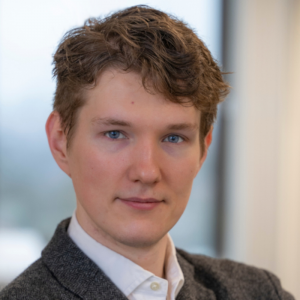
Turning neuromorphic algorithms into working hardware
Michail Rontionov is developing compiler tools that translate neuromorphic algorithms into digital FPGA hardware, aiming to bridge the gap between brain-inspired computing research and physical devices.
Research at a glance
| Research focus | Hardware-software co-design for neuromorphic computing |
| MINDS theme | Task-Optimised Devices and Systems |
| Technologies | Compilers, FPGAs, formal methods |
| Featured software | NIR2FPGA |
| Current status | Doctoral researcher |
| Expected completion | 2028 |
From brain-inspired algorithms to physical hardware
Neuromorphic computing takes inspiration from the way biological nervous systems process information. Researchers use these ideas to design new approaches to computation and machine learning, with the aim of building AI systems that are more compact and energy-efficient than conventional approaches.
Neuromorphic algorithms are usually designed and tested in software simulators. Moving an algorithm from a simulator onto physical hardware, without losing accuracy, flexibility or efficiency, is difficult. Algorithms, simulators and hardware architectures describe neural systems in different ways, and there is no standard method for translating between them. That inconsistency makes systems harder to reproduce, compare and develop.
Michail is investigating how compiler technology can bridge this gap. A compiler is software that converts a description written in one form into another form that a machine can run. His research explores how a description of a neural system, created in a simulator, can be translated systematically into a design that operates on digital hardware.
Why better translation tools matter
Testing ideas on real hardware
Reliable translation tools could make it easier for researchers to take a working neuromorphic algorithm and evaluate it on physical hardware, rather than in simulation alone.
Confidence in the result
A systematic, formally defined translation process aims to give researchers and engineers confidence that the hardware behaves as the original algorithm intended.
Towards specialised AI hardware
In the longer term, approaches like these could contribute to more compact and specialised forms of machine-learning hardware.
Research approach
Michail’s work sits in hardware-software co-design, where the software description of a system and the hardware that runs it are developed together. His target hardware is the FPGA (field-programmable gate array), a type of chip whose internal circuitry can be reconfigured after manufacture. This makes FPGAs a practical platform for building and testing new hardware designs without fabricating a custom chip.
To make the translation from simulator to FPGA more systematic, his research draws on compiler techniques, including ideas from category theory and dependently typed programming languages. Category theory is a branch of mathematics concerned with structures and the relationships between them. Dependently typed languages allow precise properties of a program to be stated and checked as part of the program itself. Together, these ideas offer a way to describe each step of the translation precisely.
His doctoral research has two phases. The first produced NIR2FPGA, a working compilation tool. The second is developing a formal framework for the same translation problem.
Research and outputs
Featured output: NIR2FPGA
NIR2FPGA is a compilation tool developed in the first phase of Michail’s doctorate. It takes a neuromorphic algorithm defined in a software simulator and compiles it into a hardware implementation for an FPGA through a formally defined set of steps, with the aim of producing efficient hardware.
Michail presented NIR2FPGA in a flash talk at NEXT-AI 2026. Read more in MINDS researchers present at NEXT-AI 2026.
Research profiles
Formal methods and future direction
In the second phase of his doctorate, Michail is using Agda, a dependently typed language used for formal verification, to build a mathematically rigorous framework for translating neuromorphic algorithms into hardware. The aim is to describe the translation precisely enough that its correctness can be checked.
His current work focuses on digital hardware. In the future, this formal approach could be extended to support analogue computing devices as well.
Michail expects to complete his doctorate in 2028 and is planning a career in industry research and development.
Related MINDS content
MINDS researchers present at NEXT-AI 2026 (May 2026): MINDS postgraduate researchers, including Michail, share their work at NEXT-AI 2026, where Michail presented NIR2FPGA.
Connect with Michail
Interested in neuromorphic hardware, FPGA design or compiler tools for brain-inspired computing? Connect with Michail on LinkedIn, explore his code on GitHub, or contact the MINDS team.