

Two MINDS doctoral researchers travelled to Loughborough in April 2026 to present their work at NEXT-AI, a national workshop on neuromorphic technologies and hardware-enabled AI. It brought together researchers, industry representatives and exhibitors from across the field.
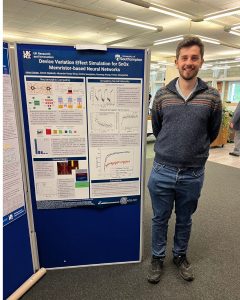
Aiden Graham presented a poster examining how variation in the physical properties of memristor devices affects the classification accuracy of neural networks. Memristors are being explored as a more energy-efficient alternative to conventional computing hardware, and understanding how device-to-device variation behaves at a network level is a practical step toward making that technology reliable at scale. For Aiden, the event confirmed something broader: industry was visibly present, with companies at their own stands and sector representatives on panels. Neuromorphic computing technologies are moving out of the lab and toward the market.
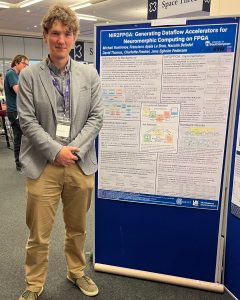
Michail Rontionov presented NIR2FPGA, a compilation tool that takes a neuromorphic algorithm defined in a software simulator and produces an energy-efficient hardware implementation on an FPGA through a formally defined set of steps. The work addresses a real gap in neuromorphic co-design: the difficulty of moving consistently between software and hardware frameworks without losing accuracy or flexibility. NEXT-AI was Michail’s first public flash talk. He came away with new research contacts and a clearer sense of where his contribution sits within the wider field.
The conversations between sessions turned out to be as valuable as the formal programme. The neuromorphic computing field draws from an unusually wide range of disciplines, and being in a room where researchers from neurobiology, photonics, materials science and electronics are all engaging with the same set of problems gave both researchers a practical test of how their work lands beyond Southampton.