

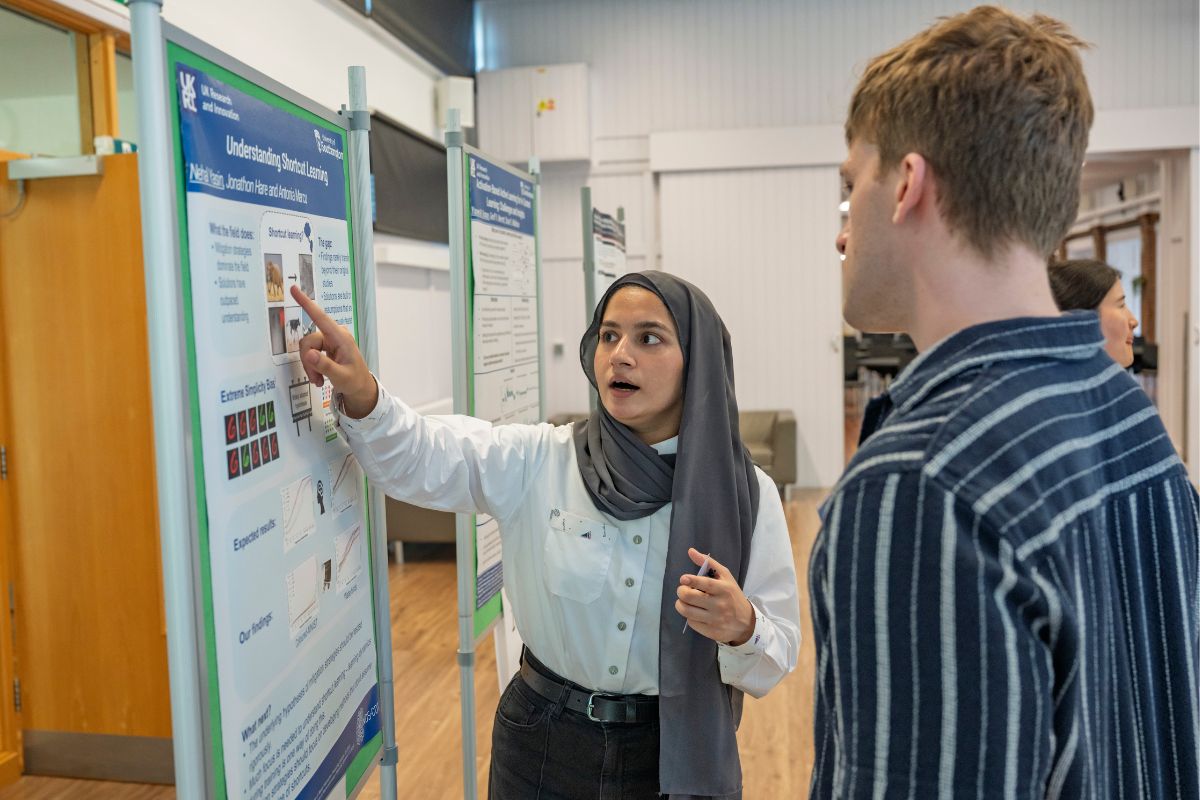
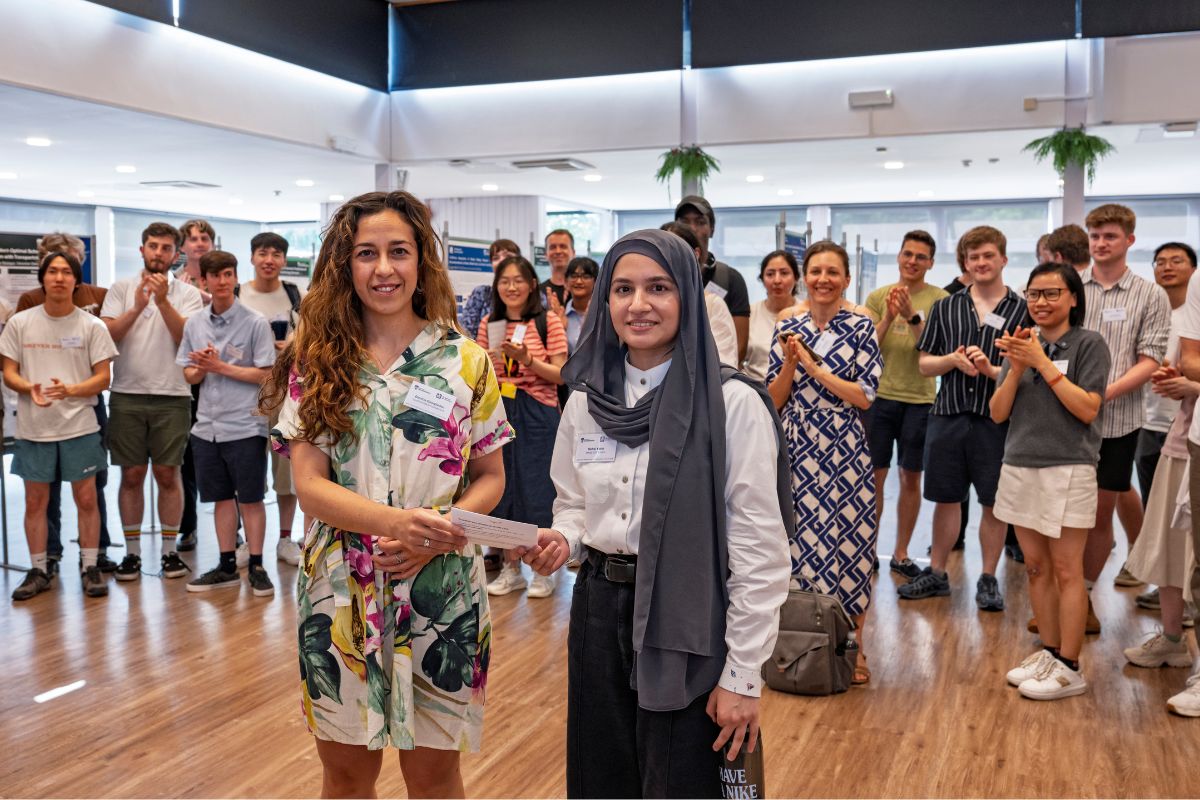
MINDS postgraduate researcher Nehal Yasin is investigating why machine-learning models rely on convenient patterns instead of learning the full range of information available to them. Her poster, Understanding Shortcut Learning, won the MINDS poster competition at the 2026 MINDS and SustAI Showcase.
When the right answer comes from the wrong clue
A machine-learning model can perform well in testing while relying on a pattern that will not remain dependable outside its training environment.
This problem is known as shortcut learning, or simplicity bias. Instead of learning all the patterns available in its training data, a model may depend heavily on the feature that is easiest to learn.
A model trained to identify elephants, for example, might associate them primarily with grey texture rather than learning their shape. A bird classifier might rely on a blue background rather than the distinguishing features of the bird itself.
These patterns may be genuinely present in the training data. The difficulty arises when the model overlooks the other information it needs to make dependable decisions in new settings.
Looking inside the learning process
Nehal Yasin’s PhD, Improving Robustness of Lightweight Models through Decision Compositionality, examines what happens internally when models learn these shortcuts.
Her research considers models’ internal composition, learning dynamics, weight updates and gradients. By studying how learning develops, she is investigating where models begin to favour irrelevant or incomplete patterns.
She is also exploring pattern diversification: how models might be encouraged to learn from a broader range of the information available in their training data rather than allowing one feature to dominate their decisions.
This work contributes to the wider challenge of robust generalisation, which asks whether a model can continue to perform effectively when it encounters data or circumstances that differ from those seen during training.
Questioning how models explain their decisions
One strand of Nehal Yasin’s research examines saliency methods, which are commonly used to highlight the parts of an input associated with a model’s prediction.
Her work Is Saliency Really Captured By Gradient?, with supervisors Jonathon Hare and Antonia Marcu, examines whether gradient-based explanations reliably identify the features on which a model depends.
A further strand of her work questions whether established hypotheses about shortcut learning generalise consistently enough to support mitigation strategies. Together, these projects examine both how shortcut learning develops and how researchers can evaluate claims about it more systematically.
Research recognised at the MINDS Showcase
Nehal Yasin presented this research through her poster, Understanding Shortcut Learning, at the 2026 MINDS and SustAI Showcase.
The poster won the MINDS competition, providing recognition for research into a fundamental question for dependable machine learning: not simply whether a model reaches the right answer, but what it learned in order to reach it.
Her work is particularly connected to representation learning and computer vision, while the underlying challenge of models relying on incomplete patterns can also arise in other forms of machine-learning data.
Explore Nehal Yasin’s research through her MINDS profile, and visit the 2026 MINDS and SustAI Showcase round-up for more research from the event.