
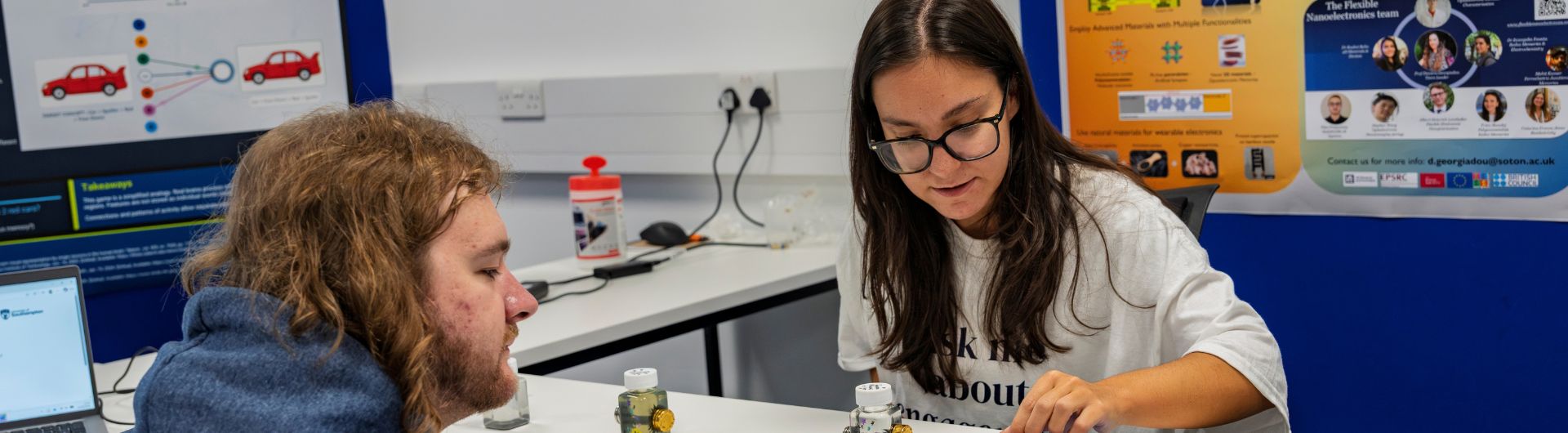
The brain holds far more neurons, and far more connections between them, than most people imagine. At the British Science Festival on Saturday 19 September 2026, MINDS postgraduate researcher Xander Lowe watched visitors discover that for themselves, one connection at a time.
“It was interesting to see how much people underestimated the scale of the brain,” Xander says.
Building connections by hand
Xander’s demonstration, Connect the Concept, lets visitors join model neurons together and send a signal down each connection. Its name comes from the way the brain is believed to build concepts through the connections it forms. During development it was known as the Neural Game.
The idea reaches beyond biology. If the brain stores concepts through its connections, that structure can inform how engineers design computer hardware. This is the thinking behind neuromorphic computing: hardware inspired by how the brain works.
Xander’s PhD is in computational neuroscience. He studies how the brain holds information in the short term, combining wet-lab electrophysiology, which records the electrical activity of real neurons, with in-silico models of the same processes.
Start simple, then follow the visitor
His table sat in a run of neuroscience exhibits. Visitors met neurons at the stand before his, then moved on afterwards to learn about synapses and how those ideas might be copied in technology. Xander simplified his game so it would suit a wide range of visitors, because “the goal was simply to emphasise the significance of connectivity within the brain.”
The simple version opened the door to longer conversations. “Having a simple concept engages conversation,” Xander says, “and from that you can judge how technical a discussion people might be looking for.” Some visitors played the game more than once.
A field worth noticing
One exchange stayed with him. A visitor was pleased to hear that neuromorphic technologies were being researched at all, and told Xander he felt it was an under-explored field.
The day had a personal side too. Xander went to science festivals in Southampton when he was younger, and sees running a stand as part of a researcher’s job: “I think it is important and our responsibility to help foster curiosity in science and technology.”
Find out more about Xander’s research, or read about all four demonstrations in our British Science Festival round-up.